
Second Chance Points: UIC Flames
A team trending in the wrong direction hoping to bounce back from some ugly losses

It’s snuck up on everyone, but we’ve got our first conference game of the season tomorrow (12/13) when UIC heads down to Nashville to play Belmont. The league schedule has gotten more complex now that there are 11 teams in the Missouri Valley Conference. On the regular game nights (Weds./Thu. & Sat./Sun.), one team will always not be playing, so in essence, almost every team will have a “bye” of sorts when they play just one conference game in a week, instead of two.
The remainder of the league doesn’t start until the middle of next week, so my bigger previews will be coming then. But for now, enjoy my second look at the Flames.
2025 Advanced Stats
Adjusted Offensive Efficiency: 103.8 (235 Overall / 8th MVC)
Adjusted Defensive Efficiency: 108.0 (187 Overall / 10th MVC)
Effective Field Goal % Offense: 46.8 (295 / 9th MVC)
Effective Field Goal % Defense: 49.4 (120 / 8th MVC)
Turnover % (Offense): 20.1 (298 / 11th MVC)
Turnover % (Defense): 19.7 (82 / 3rd MVC)
Offensive Rebound %: 39.2 (18 / 1st MVC)
Offensive Rebound % (Defense): 38.3 (343 / 11th MVC)
Free Throw Rate (Offense): 46.2 (30 / 1st MVC)
Free Throw Rate (Defense): 36.0 (181 / 8th MVC)
Statistics are publicly available from Bart Torvik’s website. I can’t recommend this site enough for how much amazing data there is as well as making this publicly available for free. If any of these are confusing to you, I plan on publishing a detailed guide on how to understand these fully. Just know for now, that these are better indicators of a team’s real abilities because they aren’t just counting stats, they look at pace of games and/or quality of opponents.
December Update
Hope is a fickle thing. In today’s society, we’re always measured by our most recent moments and the broader term view is often lost if not ignored entirely. There’s a temptation to look at UIC where they stand right now and bury them for the season.
It’d be easy to do so, considering they’ve lost three in a row and four of five going into conference play. One of those losses was to Arkansas Pine-Bluff, who had come into that game at 0-8 and was getting blown out by 20+ points in nearly every game they had played on the season. And, don’t get me wrong, I actually watched a ton of that game. UIC was truly dreadful in that game, especially offensively.
But, every situation has a level of a silver lining that can help you envision things getting better. UIC does a few things really well (rebound, get to the line, make free throws) that can be building blocks for the MVC part of the season.
Getting healthy, as you’ll see in the player updates, would be huge for the Flames as well.
How They Beat You
Offensive rebounding - UIC heads to conference play leading all Valley teams with 14.0 offensive rebounds per game. If you extrapolate that rate across all teams, UIC is 18th nationally in offensive rebounding percentage (39.2). So, even though UIC might not be the best offensive team, if you allow them to grab offensive rebounds, it can mitigate some of their shooting difficulties.
Free throws earned & made - UIC gets to the line often (30th in free throw rate in the country) but also makes them at a great percentage (76%, 1st in the Valley).
Pressure defense - The Flames show flashes of really good defense on multiple levels. They’re second in the Valley in blocked shots (4.78/game) and are solidly in the middle of the pack on 3-point field goal percentage allowed (31%).
How to Beat Them
Offensive Turnovers - UIC heads to conference play dead last in the Valley with a 20.1 offensive turnover percentage. This is basically saying that about 1 in 5 possessions end in a turnover, which isn’t sustainable for success.
Defensive Rebounding - As good as the Flames are at getting second chances on offense, they are equally almost as poor in allowing their opponents too many second shots as well. UIC gave up 23 second chance points in its loss to Robert Morris and 19 in the loss to Yale.
Three-point Shooting - UIC has hit a paltry 30.4% of its threes so far this season. Aside from Andy Johnson, mostly everyone else is hitting 32% or lower through nine games.
Primary Depth Chart
(The caveat, of course, with every team is these are not straight subs generally and teams play with a variety of different combinations.)
PG - Elijah Crawford (#2) * / Andy Johnson (#14)
Combo G - Ahmad Henderson II (#0) / Josiah Hammons (#10)
SG - Rashun Washington Jr. (#5) ) / Sam Silverstein (#20)
SF/PF - Mekhi Lowery (#22) / Jayce Nathaniel (#1)
PF/C - Ante Beljan (#21) * / Abdul Momoh (#7)
This depth chart takes some real liberties as a bunch of these roles are fluid. Some comments on these are as follows:
Johnson isn’t really a point guard, but nobody really is since Crawford got hurt. You see a variety of guys taking the ball up the court, including even Lowery, who plays in the post but functions as a point guard to start the offense regularly.
The five guards rotate relatively interchangeably. Johnson plays the most (30.1 MPG) and Hammons the least (14.4 MPG), but most are in the 20 minute range.
Two of the three big men are pretty much always on the floor and all are good rebounders.
Midseason Player Updates
(I put together write ups of everyone I expected to contribute at the beginning of the season. Please go back and read these, if you haven’t already.)
Injured Players
2 Elijah Crawford (6’3”, 187, Sophomore, Guard; previous: BYU)
I always hope for every team to put out their best teams and so it’s really disappointing the UIC has only really gotten 1 1/2 games from Crawford so far this season.
News around injuries is generally fairly sparse, but I did notice him in a walking boot at the Yale game:
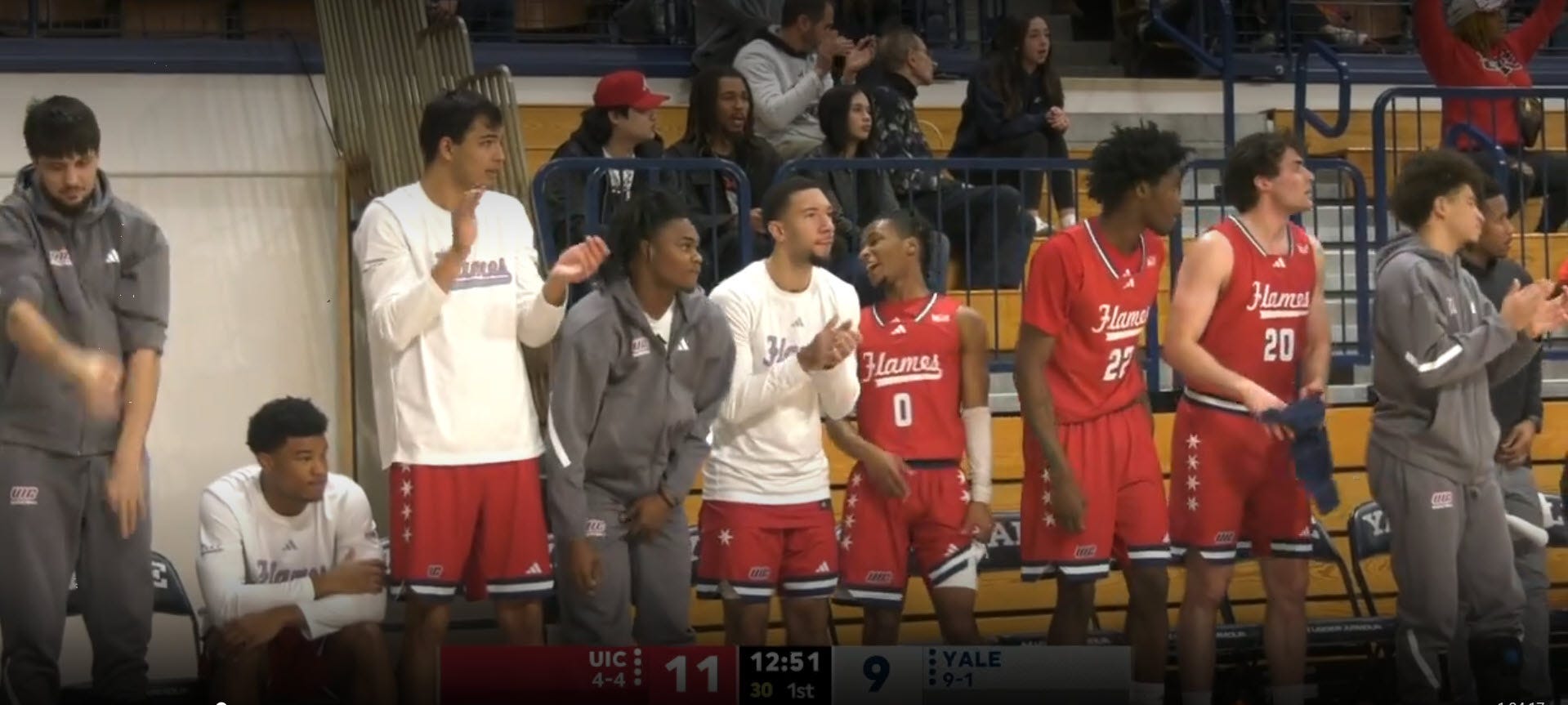
(Crawford is at the far right in street clothes; Beljan, who was also in a boot, is at the far right.)
As I noted in my recap after the one full game he did play, he definitely turned his ankle in that game pretty significantly, so while I’m not the team doctor, you do have to wonder if it was that incident that has held him out.
Hopefully he gets back the floor for the Flames because the team looks so much deeper and more talented with him running the offense.
21 Ante Beljan (6’10”, 241, Redshirt Junior, Forward; previous: Little Rock)
Speaking of Beljan, he’s been able to play more but hasn’t seen action since Nov. 22 with a lower body injury. It remains to be seen how big of a contributor he will be once he returns as he had a huge 20 point game against non-Div. I opponent St. Francis (Ill.) but didn’t add a ton in the other games. Even just having another player who can take up space in the middle would be helpful for UIC’s depth.
Key Players
0 Ahmad Henderson II (5’10”, 144, Junior, Guard; previous: Niagara)
Henderson has become the focal point of the offense. He’s averaging 15.7 PPG, which puts him in the top five of Valley players entering conference play. All my initial evaluations about the type of player he is continue to be true. I’d call him a “volume” shooter right now as his stat lines (40.2 FG%, 31.4 3PT%) aren’t stellar and he doesn’t rebound much either.
As a result, even though the points per game number is high, his offensive rating is the lowest of all the regular starters. Don’t foul him though. He’s gotten there a lot (48 attempts) and is making nearly 90% of them.
One other interesting thing about Henderson is that even though he’s the shortest guy on the team by a pretty wide margin, he rarely ever takes the ball up the court. He often starts possessions at the free throw line and then breaks off and around screens to get open. Henderson is a good player but they probably would be a better team if he didn’t need to take as many shots per game as he does.
14 Andy Johnson (6’6”, 197, Freshman, Guard; previous: Cooper HS (Ky.))
Just by averaging 14.0 PPG to this point, Johnson’s going to be on most people’s short lists for the all-freshman team in the Valley. He definitely doesn’t play like he’s in his first-year, especially in his positive assist-to-turnover ratio (17 assists, 13 turnovers), somewhat of a rarity on the Flames.
He’s been much more efficient from 3-point range (38.6%) and is also deadly from the line (90.2%). The craziest stat line for Johnson is his percentages on two-pointers where he’s actually shooting a lower percentage (37.5%) overall than he does from distance, a stat you almost never see. Broken down further, he’s made just 22% of his two-pointers that weren’t layups, dunks or putbacks. That has to improve if he’s going to take the next step for UIC.
22 Mekhi Lowery (6’7”, 204, Junior, Guard; previous: Towson)
Lowery continues to make winning plays every time I watch UIC. It starts with his rebounding. I haven’t compiled an “all strength” team to this point for the Valley, but I’m rather certain he’d be on it. He doesn’t just look the part, though, as he’s averaging 6.6 RPG which is good for 6th among Valley players heading into conference play.
And since he’s so aggressive, he gets to the line a lot and is another Flames player who shoots it well (72.7%). Maybe most notably is that he actually leads the teams in assists (27). He’s a good ball handler as evidenced by him bringing the ball up regularly on offense, which I didn’t anticipate.
He’s not elite at scoring, as evidenced by his .526 shooting percentage close to the basket, which puts him around 60th in the Valley. So, his offensive game is limited, but he still contributes in other ways.
1 Jayce Nathaniel (6’8”, 227, Freshman, Forward; previous: AZ Compass Prep (Ga.))
While they don’t really look alike, Nathaniel and Lowery as somewhat brothers in how they play on the floor. Both are rebound-first, strong, athletic power forward types that can really get after it on the glass. Their statistical profiles are really similar, even in the amount of shots they’ve taken, rebounding, etc.
Nathaniel doesn’t handle the ball like Lowery does, but he does have a bit more range in his game. It’s fun to see them both in the game at the same time because UIC can really dominate on the glass when they are both crashing.
5 Rashund Washington Jr. (6’5”, 197. Freshman, Guard; previous: East Laurens HS (Ga.))
Washington’s ability to score both inside and on the perimeter has grown, but in opposite ways from when I first watched him.
First, the good. He’s been elite at scoring around the basket, making 81.5% of his close two-point shots (22-of-27). For anyone whose even attempted more than 20, that’s the best percentage of anyone in the Valley. This is all the more impressive when you consider nearly every other guy who shoots that well close to the basket is a pure post player.
On the other side, even though his shot looks good from three, he’s only shooting at a 30% clip. He’s still just a freshman, so it’s probably something that will improve from the quality of opportunities he’s taking (versus Henderson, for example, who sometimes forces his shots).
The sad part is he’s the exact type of player that a bigger school is going to try and pick off in the off-season with his potential. But, hopefully for the Flames sake, he stays around and develops.
Role Players
10 Josiah Hammons (6’2”, 180, Graduate Student, Guard; previous: Sam Houston)
Hammons has come off the bench every game and is a second or third option when Washington or Henderson are out there. He doesn’t rebound much (0.8 RPG), shoot for a high percentage (34.6% overall, 32.4% from 3) or distribute often (three assists, five turnovers across nine games).
You put this all together and his overall team contribution is lowest on the team (-4.6 BPM). Since he’s as experienced as he is, the likelihood of a big improvement is less than some of the younger players.
7 Abdul Momoh (6’8”, 249, Graduate Student, Forward; previous: Central Connecticut State)
Momoh still looks the part of one of the better defensive players in the Valley. Some of the metrics around him aren’t as positive as the eye test, aside from his 15 blocks, which would be top 10 in the Valley. There’s no way to effectively quantify this, but I do wonder if the ability of Lowery and Nathaniel to rebound so well cuts down on his counting stats.
He’s not skilled offensively and even close to the basket, he’s made just 41.7% of his shots.
In some ways, this almost feels a little bit harsh because Momoh is a useful player to have on a team and the stats don’t always reflect as well with players of his profile.
20 Sam Silverstein (6’6”, 219, Graduate Student, Guard; previous: Cal Baptist)
No major new thoughts on Silverstein. He has his limitations on offense (40.6% overall shooting, missed all seven 3-point attempts, only 50% from the line). But he still has that scrappiness on defense that winning teams need and continues to rebound better than he should for his size.
Not on the Team
Chris Walker (6’6”, 206, Redshirt Senior, Guard; previous: Binghamton)
I mentioned Walker in the initial preview noting that he was injured and could be out for the season. Now he’s already done at UIC without playing a game, choosing to redshirt this season and also entering the portal a few weeks ago: https://x.com/tobias_bass/status/1993025090397913388?s=20
Non-Conference Schedule Results
Could it have gone much worse for UIC in non-conference play? On the surface, a 4-5 record isn’t a total disaster. But, unpacking it a little you can see why things look so bleak.
The Flames already had one of the weaker non-conference slates on paper. Their best win? Detroit Mercy, who is 4-6 overall (actually 2-6 against Div. I teams) and has a 290 NET ranking is not something you put a banner up for doing. The other three wins were against two weaker D-I schools and a non-DI game.
The stunner was that 63-62 loss at home to Arkansas Pine Bluff. It was a strange start time (11 AM) to account for schools attending the game and it ranked as the second worst offensive performance by any Valley team all season to this point.
I do give UIC credit for hanging with Yale. The Flames could have rolled over after that rough loss but gave a pretty good Yale team a competitive game on the road that could have been a win if they didn’t go 8-plus minutes without scoring between the end of the first and start of the second half. The final score looked more lopsided after both Coach Ehsan and Henderson both got technical fouls late in the game.